


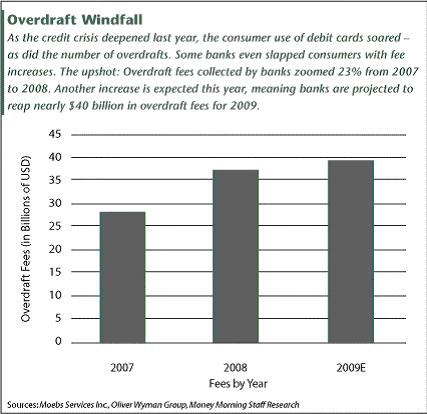
Charges related to overdrawn accounts this year may add up to $38.5 billion in revenue for banks following last year's $36.7 billion, according to data from research firm Moebs Services Inc. That's up from $28 billion collected in 2007, according to consulting firm Oliver Wyman Group.
But sneaky and manipulative ways in which banks collect these fees has caught the attention of Washington.
U.S. Sen. Christopher Dodd, D-CT, - who heads the Senate Banking Committee - earlier this week introduced a bill to limit overdraft charges with several measures. While introducing the bill at a press conference, the senator was joined by Connecticut resident Mario Livieri, who Dodd says was unfairly hit with overdraft fees this year.
"At a time when many can afford it least, Connecticut consumers like Mario are being hit with hundreds of dollars in penalties for overdrawing on their account by just a few dollars," Dodd said. "Banks should not be trying to bolster their profits at the expense of their customers."
If passed, Dodd's bill - dubbed The Fairness and Accountability in Receiving (FAIR) Overdraft Coverage Act - would:
- Require banks to get a customer's consent before enrolling them in so-called "overdraft protection" program for ATM and debit card transactions.
- Limit the number of overdraft coverage fees banks can charge to one per month and six per year.
- Require fees be proportional to the cost of processing the overdraft.
- Stop institutions from manipulating the order in which they post transactions in order to rack up extra fees.
- Require customers be notified when they overdraw their account and be given the option of being notified by e-mail, text or traditional mail.
- And require that customers be warned if an ATM or branch teller transaction will overdraw their account, and be given the chance to cancel the transaction.
No federal laws have yet been passed that regulate overdraft fees, which more banks turned to as the credit crisis began and some credit card charges went away after Congress passed the Credit Card Accountability, Responsibility, and Disclosure (CARD) Act of 2009.
But it's not for a lack of trying.
Since 2005, U.S. Rep. Carolyn Maloney, D-NY, has been trying to get a dialogue going on her proposed Consumer Overdraft Protection Fair Practices Act, but it hasn't made it past the usual subcommittee hearings.
Another possible way Washington could clamp down on overdrafts is through U.S. President Barack Obama's proposed consumer protection agency, which is part of his administration's regulatory overhaul. Such an agency would take away the power now held by the U.S. Federal Reserve to regulate overdraft fees.
Then there's the Fed, which is considering allowing banks continue to automatically enroll customers in overdraft protection programs, and giving them a chance to opt out of the programs, CNNMoney reported.
This is the opposite of the Congressional bills, which call for an "opt in" choice.
"The Fed is finally ready to act on this abusive practice, but so far, it doesn't look like their reforms will go far enough to protect consumers," Sen. Charles Schumer wrote in a letter to Fed Chairman Ben Bernanke last week. "Making overdraft protection policies truly voluntary for customers would be a good first step, but even that is not enough. This practice needs to be totally reined in."
Banks Get Proactive
Banks are out to prove to legislators they can regulate themselves, and with good reason: JPMorgan Chase & Co. (NYSE: JPM) Chairman, Chief Executive Officer and President Jamie Dimon told analysts in a conference call last week that federal regulation of overdraft fees will likely cost his company's retail bank arm $500 million per year in profit.
While JPMorgan as a whole made $3.6 billion in the third quarter, its retail bank division showed a profit of just $7 million. The division expects to lose money next year on credit cards.
"We know we will lose a lot of money next year in cards and it could be north of a billion dollars in the first quarter and the second quarter," said Dimon. "That number will only start coming down as you see unemployment and charge-offs come down."
The big banks in the industry are among many that are taking steps to show they can tame the fees without federal impositions. For example, starting early next year, JPMorgan won't charge a fee for overdrafts less than $5 as long as accounts are brought to balance within five days. Bank of America Corp. (NYSE: BAC) will give new customers a chance to opt in to an overdraft protection program, while Wells Fargo & Co. (NYSE: WFC) will let customers opt out of a similar program.
Regulators like the House's Maloney praised such moves, but still said federal regulation is necessary.
"The steps announced by Bank of America and Chase to reduce the burden of overdraft policies on consumers are significant improvements and will be good for their customers," Maloney said. "But what we need are consistent overdraft reforms for all Americans who have or open a bank account. My Overdraft Protection Act, H.R. 1456, would require all banks to allow consumers to ask for overdraft protection, require that consumers be notified when a transaction is about to incur an overdraft fee, and require that banks post the transactions chronologically."
Federal regulations on overdraft fees may limit choices for consumers and put smaller, community banks at a competitive disadvantage, said Edward Yingling, president and CEO of the American Bankers Association in Washington.
"It is likely to encourage irresponsible personal financial management," Yingling said in a statement. "It may also make it cost prohibitive for banks - especially community banks - to offer the service if customers can regularly overdraw their accounts without incurring any penalty."
The largest banks charged the largest overdraft fees: The median fee among banks worth $50 billion or more, including Citigroup Inc. (NYSE: C), Bank of America, JPMorgan and Wells Fargo is set at $33. The median fee among all banks is $25 to $26.
News and Related Story Links:
- White House:
A New Era for Credit Cards - GovTrack:
Consumer Overdraft Protection Fair Practices Act - Overdraft Fees:
Senate Gets Tough - Senator Charles Schumer:
Schumer To Fed: Take Tougher Approach On Overdraft Fees Or Congress Will Act - Seeking Alpha:
JPMorgan Chase & Co., Inc. Q3 2009 Earnings Call Transcript - U.S. Rep. Carolyn Maloney:
Maloney Statement on Banks' Revisions to Overdraft Policies and Fees - Bloomberg News:
Dodd Introduces Legislation to Curtail Overdraft Fees