



By Keith Fitz-Gerald
Investment Director
Money Morning/The Money Map Report
For U.S.-centric investors who question whether it's really necessary to invest in "risky" overseas markets, here's an important fact to consider: It's China - not the United States - that's leading us back from the brink of a global financial collapse.
At a time when the U.S. economy continues to wrestle with joblessness, a housing hangover, and heightened inflationary fears due to a questionable central bank "exit strategy," Beijing just reported that China's economy advanced at a 7.9% clip in the second quarter, up from 6.1% in the first quarter.
This is well ahead of what most mainstream analysts had been projecting - particularly those who were writing the Red Dragon's eulogy back in January - but as we've been telling Money Morning readers since the start of the New Year, China could well be on track for growth of 8% or more this year.
If you factor in the cash that's not included in official state statistics - but that does influence economic growth - it's possible that China's growth rate could grow by an additional 3% this year and as much as 5% in 2010.
That's not likely, mind you, but it is possible. And Beijing knows it.
Largely attributed to China's massive $586 billion stimulus program, the country's economic acceleration may seem startling when juxtaposed against the travails of other major markets and the United States in particular.
While Corporate America has admittedly buoyed investor sentiment with some better-than-expected earnings of late, many stalwarts continue to struggle. Take General Electric Co. (NYSE: GE), which is widely regarded as a global company, and which saw its profits drop 47%. Credit spreads remain tight and lenders are certainly in the pits as has been amply displayed by CIT Group Inc. (NYSE: CIT), which teeters on the brink of bankruptcy. Moreover, consumers continue to struggle in the United States, Europe and Japan.
In China, however, there's a very different story coming to light. Thanks largely to an emerging middle class of 330 million people (more than the population of our entire country), Chinese consumers are coming into their own. With savings that are as much as 35% of earned income and a desire to have what we have, goods are flying off of store shelves. The expected increase in Chinese consumer spending in 2009 is greater than the forecasted consumer spending increases in the United States, Japan and the Eurozone combined.
At the same time, China's property markets are rising again, and home values are increasing as well. Automobile sales, always a litmus test for consumer health in any developing country, are up 48% from last year and are accelerating so rapidly that China is already supplanting the United States as the world's largest car market - a full three years ahead of my projections.
But, critics ask, what happens when the music stops? They're worried that once the money runs out, China's markets could crash all over again.
To China's credit, the government acknowledges that there still are challenges and, as a seasoned China watcher, that gives me comfort. I find it reassuring to see that China's leadership understands the game they're playing. In fact, there are three key areas that could trip up the country's global-growth strategy, but to keep that from happening, China's leadership is focusing carefully on each of the three: unemployment, lending and currency.
Let's look at each one in detail.
Unemployment: President Hu Jintao and his cabinet are acutely aware that if unemployment gets out of control, social unrest will become a major problem. So China's leadership will do everything it can to ensure that this doesn't happen.
Most Westerners will no doubt read into this comment with an emotional overlay, especially when the media has been filled in recent weeks with stories of the waves of riots and killings in China's Western Xinjiang region. But, they shouldn't. The Uyghur riots, while extremely unpleasant by any measure, are racially motivated clashes. That's not to downplay the tragic nature of this violence, but the very nature of these riots does suggest that the chance they'll spread beyond the largely Muslim region is minimal.
What concerns Beijing when it comes to unemployment is that riots spawned by shortages of basic human needs are a very different phenomena because they could prompt a now-divided and largely indifferent populace to unite against the government across a much broader geographic area.
And that would not only risk China's growth, but powerful ruling elite, too, which is why Beijing is so insistent on direct stimulus benefits that keep people working. If it hasn't dawned on you, yet, I'm sure it will in short order - China is playing it smart.
Here in the United States, Washington took its turnaround plans to Wall Street.
But in China, Beijing has taken its plans to Main Street.
While our leaders continue to pay lip service to unemployment, they really don't care so long as protected (and connected) institutions remain standing when they should have been put out of their misery.
Lending: Since this crisis began, China has largely avoided the financial plague that has devastated Western economies. This is due in large part to historically tight restrictions on local banking practices and the confinement of derivatives and other potentially toxic financial assets to a few externally focused banks. But now Beijing has a different issue to contend with.
To ensure that the stimulus programs flow freely throughout China - and have the beneficial impact that Beijing hopes - Beijing's bankers have more recently liberalized lending and reserve requirements inside China. This has resulted in an explosion of debt that many Western analysts believe will come back to haunt China in much the same way the lending orgy here continues to haunt U.S. financial institutions today. They're entirely different forms of lending, but the concerns seem to be inseparable.
To be fair, that might be the case. However, the thing to keep in mind is that China is not just changing the rules in isolation the way the United States did leading up to the financial crisis. Instead, we're seeing stronger internal controls being developed, increasingly strict layers of banking supervision being installed, and a general rise in the quality of borrowers - all at Beijing's insistence.
The result of all this is that China's financial system should become increasingly stable even as it grows by leaps and bounds.
Obviously there will be fits and starts, but this is a far cry from the warped system U.S. investors have been forced to rely upon to date - a system whose hallmarks seem to be inept leadership, somnambulant or sleazy regulators, conflicted lenders and greedy Wall Street executives who focus on profits no matter the cost.
Chinese Currency: Many Western observers worry about China's intentions when it comes time to purchase our debt. I think that's overblown. The real question is what Beijing will do to manage the concentrated U.S. dollar risk it currently faces.
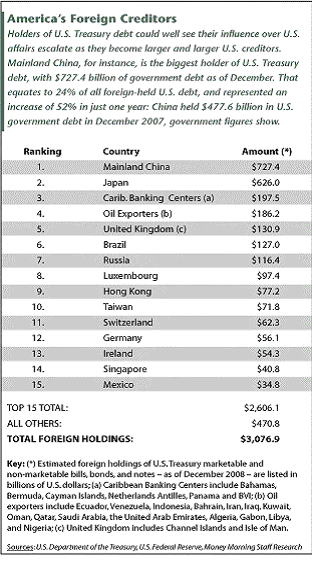
To the extent that China can keep a lid on its unemployment situation and maintain control over its banking system, expect China to maintain the status quo and to continue its purchases of U.S. Treasuries and U.S. dollars. But don't expect it to sit still. China is acutely aware of the highly concentrated risks it faces because of its ongoing dealings with the United States.
Therefore it's logical to expect China to diversify its holdings with additional oil, gold and resources purchases in the months ahead. Not only will resource-specific investments help hedge the $2.3 trillion currency-reserve risk China bears, but if the dollar collapses such "hard-asset" investments will maintain much of their value and will be eminently tradable via the $120 billion in yuan-based swap agreements that China has assembled.
Here's one final thought to consider.
Unlike the West - which views the financial crisis as a burden, a mistake, or a bad dream to be lived through - China's leaders see this as the most significant opportunity of a generation. It's a chance for their country to establish itself as a leading global power.
That's why China will continue to pull further ahead. And that's why U.S. investors who don't wish to be left behind can no longer ignore China.
[Editor's Note: Fifteen trades. All profitable. Since launching his Geiger Index trading service late last year, Money Morning Investment Director Keith Fitz-Gerald is a perfect 15 for 15, meaning he's closed every single one of his trades at a profit. And he did this during one of the most volatile periods for the U.S. stock market since the Great Depression. Fitz-Gerald says the ongoing financial crisis has changed the investing game forever, and has created a completely new set of rules that investors must understand to survive and profit in this new era. Check out our latest insights on these new rules, this new market environment, and this new service, the Geiger Index.]
News and Related Story Links:
-
Money Morning News Analysis:
The Three Ways China May Deal With Growing U.S. Debt. -
Money Morning News Analysis:
Goldilocks, Gloom or Doom? Three Views of a U.S. Recovery. -
The Big Money:
Why China is a Dangerous Place for Your Money. -
Money Morning News Analysis:
Mixed Data Shows China's Stimulus Working, but More May be Needed. -
Wikipedia:
Musical Chairs. -
InvestorPlace.com:
How to Profit as China Flees U.S. Stocks. -
Money Morning News Analysis:
How to Profit From China's "Hot Money" Strategy. -
Wikipedia:
Hu Jintao. -
Wikipedia:
Xinjiang region. -
Money Morning Market Analysis:
China Seeks to Dethrone the Dollar -
Money Morning Special Report:
Hot Stocks: Three Reasons Apple is Bucking the Recession. -
Money Morning Global Investing News Briefs:
CIT May Still Face Bankruptcy. -
Money Morning News Analysis:
Ford Loss Narrows as It Heads for a Rebound.
About the Author
Keith is a seasoned market analyst and professional trader with more than 37 years of global experience. He is one of very few experts to correctly see both the dot.bomb crisis and the ongoing financial crisis coming ahead of time - and one of even fewer to help millions of investors around the world successfully navigate them both. Forbes hailed him as a "Market Visionary." He is a regular on FOX Business News and Yahoo! Finance, and his observations have been featured in Bloomberg, The Wall Street Journal, WIRED, and MarketWatch. Keith previously led The Money Map Report, Money Map's flagship newsletter, as Chief Investment Strategist, from 20007 to 2020. Keith holds a BS in management and finance from Skidmore College and an MS in international finance (with a focus on Japanese business science) from Chaminade University. He regularly travels the world in search of investment opportunities others don't yet see or understand.