


[This is the second installment of a two-story package that examines how the global financial crisis has put the squeeze on retirement funds. Today(Friday) Money Morning looks at strategies investors can use to bounce back from a big drop in the value of their 401(k) retirement plans. In Part I yesterday (Thursday), we looked at how badly pension funds have been hit by the crisis.]
By Mike Caggeso
Associate Editor
Money Morning
For the 50 million Americans with 401(k) plans - many of them close-to-retirement Baby Boomers - the heavy lifting is just beginning.
In the 12 months after the U.S. stock market hit its record peak in October 2007, more than $1 trillion worth of stock-market wealth held in 401(k)s and other "defined-contribution" plans was eviscerated, The Wall Street Journal reported. The lost wealth is more like $2 trillion if individual retirement accounts (IRAs) are taken into account.
For many, the pain will be especially acute. For instance, workers aged 55 to 64, who have been contributing to the same 401(k) plan for the past 20 years, have seen their the 401(k) account balance plunge by a staggering 25%-plus since the start of 2008, according to research by the Employee Benefit Research Institute. Since those figures don't separate out new cash contributions to the plans, the statistics actually tend to drastically understate the actual level of losses, The Journal reported.

Given that many Americans were already trying to deal with major declines in the values of their homes - and given that thousands of households are dealing with, or are expecting, job losses - this eradication of their retirement savings is taking on a kind of "last straw" quality.
After all, any one of those three things alone - falling housing prices, loss of incomes due to lost jobs or a retirement plan haircut - is tough enough to rebound from. But the combination of all three is the kind of triple-whammy that can put an entire economy out for the count.
"This is the biggest test that the 401(k) plan has seen to date, and it has failed," Robyn Credico, head of defined-contribution consulting at Watson Wyatt Worldwide Inc. (WW), told The Journal. "We've put people close to retirement in a very challenging position."
There are plenty of ways to react, ranging from indifference to outright panic. Neither extreme will prove productive. However, there are some options in between that will form the foundation of any sound retirement plan rebuilding strategy.
After reviewing a plethora of options, Money Morning offers you the three best ones.
Retirement Rescue Tip No. 1: Don't Cash Out
Possibly the worst thing you could do to your retirement is cash in your 401(k) - a move that would level your finances come tax time, extend your pre-retirement career by a number of years, and/or reduce your income when you start retirement.
So let's rule that out immediately. That will put you well ahead of others who didn't resist this urge, or who were forced to make this unattractive choice due to extenuating circumstances.
In the last two months of 2008, requests to withdraw from retirement plans rose 59% from the same period in 2007.
Magnifying this mistake is the fact that the contributions participants have funneled into their retirement have steadily declined since July, HR consultancy firm Mercer Inc. reported after polling 1.2 million participants with employer-sponsored defined contribution retirement plans.
Luckily - for now - less than 1% of plan participants account for both these declines.
"What should sound the alarm with plan sponsors, however, is the growth trend, not the absolute figures. As most experts would agree, withdrawals from 401(k)-type retirement plans and reducing participant contributions to zero are two actions that are completely counter to preparing for retirement," Eric Levy, Retirement Business Leader at Mercer, said of the firm's poll. "This may point to the dire straits that a small-but-growing number of participants find themselves in where withdrawals and zero contribution rates are seen as a type of financial last resort."
Levy raises the central issue: It's less of a lack of faith that the markets will bounce back, and more of a basic need for money for daily expenditures.
That's understandable, and excusable to a large degree. After all, you won't be able to enjoy retirement if you lose your house in the process of putting away money for later.
But the bottom line is less money contributed now translates into less money you'll have to enjoy life and meet your basic daily needs after you punch that company timecard for the last time.
Sometimes you have to take one step back before you can take two steps forward.
Retirement Rescue Tip No. 2: Balance and Rebalance
The phrase "rebalance your assets" sounds intimidating. But 401(k) managers and financial planners know their clients aren't financial wizards.
They know a large portion of 401(k) participants don't have the time or knowledge to actively manage their plan's holdings. And they know investors have different tolerances for risk.
That's why 401(k) plans have asset-allocation models designed to assess a participant's risk tolerance, manage that risk and maximize returns by setting a percentage for each category of assets. Over time, these ratios can change as some assets surge in value, while others hold steady or even decline.
That, in turn, could skew your asset allocation. Assets that performed well could now comprise 20% of the portfolio's value, instead of once accounting for 15%, if other asset categories tanked.
Levy says that many employers offer quarterly or semi-quarterly rebalancing programs, as well as some that rebalance automatically.
"Conceptually, you should be regularly looking at the asset allocation of your account relative to your age and risk tolerance," Levy said. "And [you should be] looking to rebalance that at least on an annual basis if not more often."
Retirement Rescue Tip No. 3: It's a Marathon, Not a Foot Race
Since 1947, of the 11 times the quarter-over-quarter change in gross domestic product (GDP) was a minus 4% or more, the Dow Jones Industrial Average index was higher by an average of 25% one year later and 35% two years later.
This information especially applies to 401(k) participants. The reason: The more you invest when markets are down, the quicker you will recover the losses you sustained over the past two years.
Just take a look at the following chart.
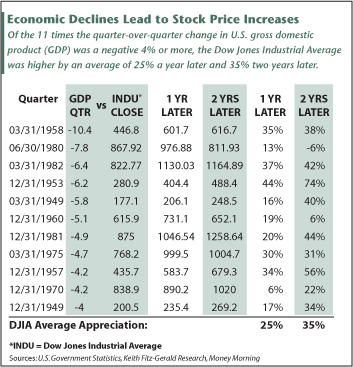
"The latest projections suggest we're right in line with historical norms, given that economists expect that the U.S. economy suffered a mind-numbing decline of 4.35% in the final quarter of last year," says Money Morning Investment Director Keith Fitz-Gerald. "When everyone else believes the worst; that's when you should be buying."
For prospective retirees - those who watched as their 401(k) plans trip and fall right before the finish line to their working days - take heart: The markets will rebound. It's just not clear when. While that may mean you have to stay in the race a little longer, consider this: You'll be able to keep contributing to your retirement cache, magnifying your retirement war chest when that rebound does come.
For those 40 and under, this is possibly the biggest opportunity to build long-term wealth in your lifetime. Keep saving. And stay focused.
[Editor's Note: Uncertainty will continue to be the watchword for at least the first part of the New Year. Little wonder, as the global financial crisis continues to whipsaw the U.S. financial markets in a manner that hasn't been seen since the Great Depression. It's almost enough to make you surrender and give up the investment game forever.
But what if you knew - ahead of time - what marketplace changes to expect? Then you'd be in the driver's seat - right? You'd know what to anticipate, could craft a profit strategy to follow, and could then just sit back, watching and waiting - and finally profiting from - the very marketplace events you anticipated.
R. Shah Gilani - a retired hedge fund manager and a nationally known expert on the U.S. credit crisis - has predicted five key financial crisis "aftershocks" that he says will create substantial profit opportunities for investors who know just what these aftershocks are, and how to play them. In the Trigger Event Strategist, Gilani uses these "trigger events," as gateways to massive profits. To find out all about these five financial-crisis aftershocks, and about the trigger-event profit strategy they feed into, check out our latest report. It's worth acting now; the price increases this weekend.]
News and Related Story Links:
- Employee Benefit Research Institute:
401(k) Balances and Changes Due to Market Volatility
- Wall Street Journal:
Big Slide in 401(k)s Spurs Calls for Change
- Money Morning Stock Market Analysis:
Are U.S. Stocks Nearing the "Sweet Spot" for Double-Digit Gains? - Securities and Exchange Commission:
Beginner's Guide to Asset Allocation, Diversification and Rebalancing. - CNNMoney.com:
Asset Allocation Calculator.