


By Don Miller
Associate Editor
Money Morning
The dismal U.S. unemployment numbers have gotten more airtime recently than Jerry Springer.
And why not?
The numbers are mind-numbing.
- A total of 2.6 million jobs lost in 2008 – the most since World War II.
- A jobless rate that’s at 7.2% – and climbing.
- About 11 million people out of work.
As usual, however, the “official” numbers don’t tell the entire story.
"People say that they know how bad the economy is. But they don't know how it feels to have the reality hit home," said Stu Schweitzer, global markets strategist at J.P. Morgan Chase & Co.'s Private Bank (JPM). "It's not the facts — it's how the facts feel. And it feels terrible to have so many Americans losing jobs, and so many more likely to follow in the coming months."
As it did last week with the government’s inflation statistics, Money Morning will now take an in-depth look at how the U.S. jobless situation may be a lot worse than the U.S. government statistics appear to show.
And “how it feels” comes home to roost with a behind-the-scenes look at the dramatic impact those horrific numbers have on the lives of just a few people caught in the crossfire.
Government Unemployment Numbers -- Not What They Seem
The official government estimates of the current unemployment problem are staggering in their own right.
- 791,000 manufacturing jobs were lost in 2008, hitting the auto sector hardest.
- 260,110 people lost jobs in the financial sector, part of the overall service sector that accounts for some 80% of all employment.
- The construction sector shed 899,000 since peaking in September 2006.
- The retail sector shed 522,000 jobs for all of 2008.
All told, 2.6 million people lost their jobs in 2008. And, to underscore the accelerating nature of the problem, more than half of those job losses occurred in the final four months of the year. In December, a total of 11.1 million were unemployed. An additional 8 million people were working part time – up sharply from 7.3 million in November.
The average workweek in December fell to 33.3 hours. That’s the lowest average on record, dating back to 1964, and a sign of more job reductions to come since businesses often cut hours before eliminating positions entirely.
Those are the “official” government numbers. But, as a closer look demonstrates, the unemployment figures can be understated – and misleading.
The government actually compiles unemployment figures in six different categories; as you might expect, the numbers tend to minimize the bad news.
The most commonly number quoted in the media is the “official” unemployment rate – known as U3 (the bottom line of the three in the chart below) – which now stands at 7.2%.
But to get the real picture, you have to add both in what the government refers to as "discouraged" workers (U4) and "marginally attached” workers (U5) – those who have stopped looking for work, or who haven’t looked for work recently (represented by the middle line of the three in the chart). That number (U6) depicts an unemployment rate t that’s approaching an eye-popping 14%.
And it gets worse.
If you include the people that the government doesn’t even count – such as unemployed farm workers, the idle self-employed, and workers in private homes – the unemployment rate approaches an astonishing 18% (top line).
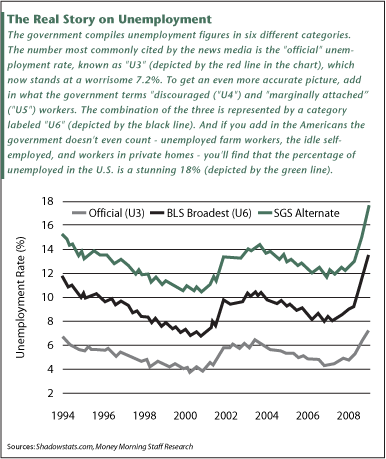
In other words, unemployment has insidiously spread to almost one-fifth of the U.S. work force, a number much larger than the single-digit figure commonly bandied about in the press.
If you regard unemployment statistics as an important means of gauging the overall health of a given economy, these “enhanced” statistics paint an ugly picture of just how painful this financial slump has become for the U.S. economy.
Layoffs of this magnitude are more than a mere shot across the bow of the economy; they’re actually a direct hit amid ship – below the water line, meaning that sinking is inevitable.
Fully 70% of all domestic economic activity is powered by consumer spending. People who are unemployed cannot buy homes, don’t shop heavily in retail stores, cut back on groceries, and are loath to take on added risk.
The numbers alone are bad enough. But in America’s heartland, many of the approximately 80% of workers thatarestill working are caught in the grip of unemployment vise as well.
No Runs, No Hits, Many Errors
Not only are record numbers of Americans suffering without jobs – they can’t even tell their troubles to a human being anymore. Most now have to navigate hard-to-use electronic systems, faceless entities that are ill-prepared to help so many people file for much-needed unemployment benefits.
With about 4.5 million Americans collecting jobless benefits, state government web sites and phone systems used to file for benefits are being overwhelmed by sheer numbers.
Electronic unemployment filing systems have crashed in at least three states amid an unprecedented crush of thousands of newly jobless Americans seeking benefits. Other states are adjusting their systems to avoid being next, The Associated Press reported.
Systems in New York, North Carolina and Ohio were shut down completely in early January by heavy volume and technical glitches. Labor officials in several other states are reporting higher-than-normal use.
And even some of the systems that are holding up under the strain are leaving filers on the line for hours before asking them to leave a message.
Still others are giving them the ultimate slap in the face: “We’re sorry, all circuits are busy.”
"Regardless of when you call, be prepared to wait and just hang on. Try not to get frustrated," Howard Cosgrove, a spokesman for the Wisconsin Department of Workforce Development, told The AP.
To stabilize a phone system that has been overloaded for weeks, his agency boosted its staffing of telephone operators by 25% last month.
"We sympathize, we're on their side, we're doing our best to help them out," he said.
Job Losses Gets Personal for Truckers
Depending on your geographic location, you might not notice when an automobile plant closes – but truckers do.
Any business closing – and the resulting layoffs – represents another loss of steady work for truckers, who are responsible for the movement of about 60% of the nation’s freight, including food and hard goods.
As many as 785 trucking companies with a combined fleet of 39,000 trucks went out of business in the third quarter of last year. Overall, more than 127,000 trucks, or 6.5% of the industry were idled in 2008, Donald Broughton, trucking analyst and managing director of Avondale Partners, told The Los Angeles Times.
That means tens of thousands of drivers previously on company payrolls are now competing with the nation’s independent owner-operators for a piece of a fast-shrinking cargo pie.
Joe Rini, from Grand River, Ohio, recently bid $3,400 to haul a load of building materials to the Pacific Northwest for one of his best customers. Usually, the load would pay $4,400, but with possible competitors in mind, Rini lowered his bid and got the contract.
Still, before he could pick it up, another trucker low-balled him with a bid of $3,000. Rini declined to match.
“I didn’t want to bid that low in the first place,” he told The Times. “I start down that road and I’m out of business.”
Elsewhere, fleet operators who so far have managed to survive are putting increasing pressure on their sales force to maintain revenues.
Despite being in the hauling business since the 1860s, Ventura Transfer Co. of Long Beach, Calif. is feeling the squeeze.
“Gone are the days where you can own a trucking fleet and just rely on the demand of the marketplace,” said Brian Olsen, Ventura Transfer’s chief executive officer.
California Dreamin’ No More
Even though he’s had no trouble so far staying gainfully employed in California, Mike Reilly, a 38-year-old engineering contractor, is leaving his home state’s lemon groves and beaches for the foothills of Denver.
California has often been called the “promised land” since the days of the Gold Rush. But in 2008, many families gave up their California dream and headed elsewhere.
With an unemployment rate of 8.4% in November, and a record 236,000 foreclosures on the books in 2008, the Golden State has lost some of its allure.
Barry Hartz lived in California for 60 years before moving close to his son’s family in Colorado Springs. Despite recent price declines from a glut of foreclosures hitting the market, he laments the escalation of home prices in the early 2000’s, “to the point our kids…could not live in the community where they grew up.”
The number of people leaving California outnumbered those moving in by a net total of 144,000 in the first six months of 2008 – more than any other state, the Associated Press reported. For the first time ever the state could lose a congressional seat.
With the state facing a $42 billion budget deficit, further tax increases and education cuts were the last straw for Reilly, the engineer.
“You see wages go down and the cost of living go up,” he said. Years of rising taxes, unchecked illegal immigration and bumper-to-bumper traffic have convinced him to move on.
What’s Next …
Overall, 48% of all companies downsized in 2008, and a staggering 60% are planning reductions in 2009, according to a Society of Human Resource Management survey.
Economists predict a net total of 1.5 million to 2 million or more jobs will vanish in 2009, and the “official” unemployment rate could hit 9% or 10%, underscoring the challenges that new U.S. President Barack Obama will face and the tough road ahead for job seekers.
Obama has called the jobs losses "a stark reminder of how urgently action is needed" to revive the nation's staggering economy. His administration is planning a stimulus package costing upwards of $800 billion, consisting of tax cuts and other ways to try to help individuals and businesses.
But unemployment is feeding into a vicious cycle that Washington policymakers are finding difficult to break. The jobless are now forcing almost all U.S. consumers – employed or not – to retrench for an uncertain future.
News and Related Story Links:
- U.S. Labor Bureau:
Labor Force Statistics from the Current Population Survey - AP Business:
Stocks slide after rise in unemployment rate - Los Angeles Times:
A tough time to keep on trucking'. - The Associated Press:
Calif. a dream no longer as residents bail.
- The Associated Press:
State unemployment claim systems overwhelmed. - Money Morning News Analysis:
The Obama Blueprint for Solving the U.S. Financial Crisis. - Wikipedia:
California Gold Rush.