



Keith Fitz-Gerald
Investment Director
Money Morning/The Money Map Report
Nut job. Alarmist. Fear monger. Dr. Doom.
I've heard them all. When you make your living as a financial analyst and commentator, as I do, you aren't going to get a lot of invitations to the ol' country club - especially if you spend a lot of time spotlighting the problems that are created by greedy Wall Streeters, sleepwalking regulators, or indentured elected officials.
But when you repeatedly warn investors that the U.S. financial system is on a collision course with disaster, and state that some investors will experience "extinction-level events" - and when you broadcast these warnings when virtually everyone else is in denial and is dismissing the market problems as "minor" - you're bound to become a marketplace outcast.
Until, of course, your predictions are proven correct.
We may be hearing from my critics again - and soon - for I've got another prediction they aren't going to like.
There clearly are countries - such as the United States and much of the European Union - that are going to collapse into recession, even if only unofficially. But this doesn't necessarily have to evolve into a global recession - a position that most of the traditional Wall Street establishment disagrees with, by the way.
Let's take a look at several of Wall Street's current misconceptions - and see why I'm selectively bullish:
- The Red Dragon (China) is ready to hibernate: Wall Street is worried that a U.S.-induced recession will slay the Red Dragon. There's no way. If a country can fall into a recession when its economy (as measured by gross domestic product, or GDP) is advancing at a 9.6% clip - at a time when its U.S. counterpart will be lucky to eke out a 1.0% growth rate - well, I'll eat my hat. The Armani Army, in its infinite wisdom, is worried about a recession in China even though its $1.9 trillion in foreign reserves are more than 32.10% of GDP and external debt is a miniscule 7.6% of GDP (external debt is defined as the amount of debt that China owes external creditors, including consumers, central governments and commercial institutions, according to the CIA Fact Book). By contrast, the U.S. reserves are 4.84% of GDP, while external debt is 84%. The United Kingdom and Switzerland are in even worse shape, with external debt of 382.2% and 279.1%, respectively.
- China won't be able to survive a drop-off in exports to the United States: Then there's the myth of China's export economy. The last time China took a header and export business dropped by 35%, its GDP dropped by less than 1%. I'm betting it will be an even smaller bump this time around, especially since China's middle class now is increasingly responsible for internal growth - independent of what China exports to the rest of the world.
- The Asian economies are an economic train wreck just waiting to happen: This was true a decade ago, when the United States and Western Europe held all the cash. But no longer. Today, nations such as Singapore, Thailand and Malaysia are running trade surpluses. So is Canada. That suggests that the currencies of these countries are significantly undervalued at a time when their economies are increasingly tied to that of China. What does that tell us? Today, China is the growth engine of Asia; tomorrow, it will be the growth engine of the world.
- The U.S. economy remains the financial center of the world: Today, an estimated 78% of global economic activity takes place outside U.S. borders, which means that even in a recession, an increasing amount of capital circulates beyond the U.S. shores. Indeed, the U.S. stock market now represents less than 30% of total world market capitalization, down from roughly 45% as recently as 2004. Don't be surprised to see the United States continue to decline in economic relevance. One day, the lion's share of the financial trades will take place beyond U.S. borders.
- Because it's a developed market, the United States remains the world's safest and most promising place to profit: In the 1980s, the United States accounted for one-third of the global economy; by 2030, that ratio will be cut in half. The reality is that U.S. investors who want to be successful in the years to come will have to learn all they can about markets whose names they can't yet pronounce.
Wall Street may not agree, but the real adage to embrace and remember is this one: It's easier to become No. 1 than it is to stay there.
There's no doubt that the "experts" who are projecting that the world markets will decline further and perhaps even collapse will take issue with my analysis. But it's important to note that I agree with you - at least in the near-term. Barring a governmentally induced Hail Mary, I think there's no question that the worst remains ahead of us.
But longer term - I'm talking three, five to 10 years - I am intrigued by the fact that so many emerging markets have collapsed in the chaos, even though the underlying economies haven't really changed. Everything we know about financial markets history and changes in market behavior suggests that countries backed by high cash reserves tend to emerge from periods of market chaos faster - and stronger - than the economies that had been at the top of the heap when the crisis first struck. [For some insight into which countries have the biggest reserves as a percentage of GDP, take a close look at the accompanying chart].
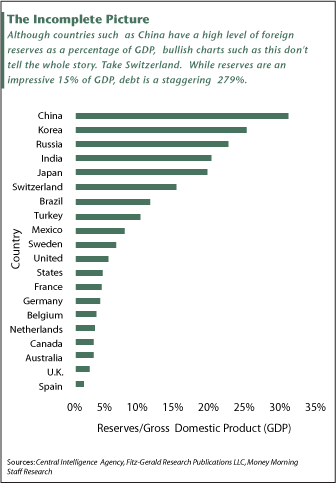
Where does that leave us? Well, in spite of what Wall Street would have us believe about the Red Dragon, this cash-reserves indicator suggests that China - and countries that have close economic ties with that country - may actually be getting more attractively valued (and not less) by the minute. That's especially true for longer-term investors.
As for the types of investments that seem most promising, given the troubled times we live in, keep focused on the simple ones. As I've long suggested, such simple profit plays have always played well during periods of similar market turmoil. So there's no reason to believe it will be any different this time around.
After all, the financial history books are filled with notable examples of real earnings and real products enjoying success over long periods of time. Particularly when those profits are being generated by companies focusing on such basic societal needs as energy or infrastructure. Barring a complete collapse in the oil business (or any perfect substitute that's eventually developed), energy, commodities and infrastructure companies will continue to offer solid upsides.
As for the U.S. dollar, after years of benign neglect, the U.S. Federal Reserve and U.S. Treasury Department will do everything they can to prop up the credit markets, In the short term, most investors will misconstrue this as a legitimate rise, all that's really happening is that longstanding risks are being overcome by governmental guarantees.
Longer term, the damage has been done. No nation I am aware of in recorded history has done more than temporarily dodge the inevitable by debasing its currency as the United States is doing right now. And that's why - at the risk of inflaming yet another bunch of Wall Street folks - I'm increasingly of the opinion that the United States is headed for a major currency crisis in the next few years. Wall Street doesn't see it, and I sure hope that I'm wrong.
For the same set of reasons, I don't think that investors should be the least bit surprised if U.S. regulators (in conjunction with their counterparts overseas) actually shut down the financial markets for a week or two while they try to sort out the credit crisis and reevaluate currency relationships that are right now being pushed to the brink of oblivion.
While this is regarded as impossibility by many - and simply incomprehensible by others - Bloomberg News reported Oct.10 that Italian Prime Minister Silvio Berlusconi said world leaders were discussing shutting down global exchanges. He later retracted his comments, saying that he didn't mean what he said.
But I think he (Berlusconi) did, and I believe they (U.S. regulators) are.
There are historical precedents for so-called "bank holidays," even here in the United States. In fact, the New York Stock Exchange closed its doors from March 4-14, 1933 as part of U.S. President Franklin Delano Roosevelt's forced holiday (Emergency Banking Act), and did so again from Sept. 11-17, 2001 following the terrorist attacks against the US.
In both instances, what's critical to understand is that the closures were designed as part of a government plan and not an overall solution. If not backed by a plan or ultimate objective, a shutdown would simply delay the inevitable, or move additional losses offshore until the U.S. markets were to reopen. Thus, even though a bank holiday would provoke terror among most investors, a globally coordinated stock market closure could also be viewed as a tremendous sign that central bankers and regulators finally understand the gravity of the situation we're facing today and literally rewriting the rules of finance in a united, global front.
That's why this reminds me of iconic investor Warren Buffett, who once reportedly quipped that investors shouldn't buy anything they wouldn't want to own for five years, if the markets were to close for that period.
Or something to that effect...
News and Related Story Notes:
-
Wikipedia:
Silvio Berlusconi. -
Wikipedia:
Bank Holidays. -
Wikipedia:
Franklin Delano Roosevelt. -
Wikipedia:
Emergency Banking Act. -
Money Morning Analysis:
Railroad Play Burlington Northern Hauling Gains for Warren Buffett's Berkshire.
About the Author
Keith is a seasoned market analyst and professional trader with more than 37 years of global experience. He is one of very few experts to correctly see both the dot.bomb crisis and the ongoing financial crisis coming ahead of time - and one of even fewer to help millions of investors around the world successfully navigate them both. Forbes hailed him as a "Market Visionary." He is a regular on FOX Business News and Yahoo! Finance, and his observations have been featured in Bloomberg, The Wall Street Journal, WIRED, and MarketWatch. Keith previously led The Money Map Report, Money Map's flagship newsletter, as Chief Investment Strategist, from 20007 to 2020. Keith holds a BS in management and finance from Skidmore College and an MS in international finance (with a focus on Japanese business science) from Chaminade University. He regularly travels the world in search of investment opportunities others don't yet see or understand.