


By Jennifer Yousfi
Managing Editor
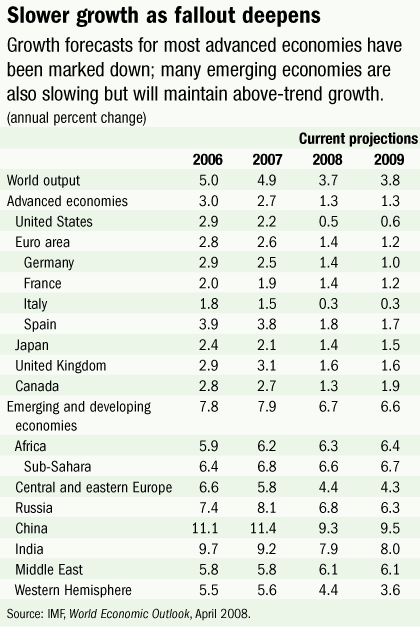
Global growth will slow to 3.7% in 2008, the International Monetary Fund announced yesterday (Wednesday), in its most recent World Economic Outlook.
There is also a 25% chance of a global recession should economic growth fall below 3% in 2008 or 2009.
The United States will largely be responsible for worldwide deceleration due to the steep correction in the U.S. housing market and continued fallout from the credit crisis, which started in the subprime sector and has spread throughout the financial system.
The IMF forecast the U.S. economy would slip into a recession in 2008, with only a slight recovery in 2009. Its projection for the United States’ economic growth in the current year is 0.5% followed by a slight increase to 0.6% in 2009.
The IMF is predicting nearly all world economies will slow this year, with the noted exception of the Middle East, which is expected to increase slightly to 6.1% from 5.8%.
Story continues below...
And while emerging markets such as China will slow, the Asian nation is still expected to grow at a 9.3% rate, while India is expected to grow at a 7.9% rate. [For a full listing of the IMF’s economic forecasts, please see the chart below.]
"The worst is not yet over," David Bloom, global head of currency strategy at HSBC Holdings PLC (HBC) in London, told Bloomberg News. "If the IMF predictions prove true, it demands an urgent policy response to galvanize the world economy."
IMF Board members agreed that central banks such as the U.S. Federal Reserve and European Central Bank might be forced to lower interest rates in a bid to spur economic activity. The Fed has already lowered interest rates 3% to the current federal funds rate of 2.25% since September.
IMF Survey reported that IMF Chief Economist Simon Johnson noted high commodity costs as another drag on the global economy and said that "the effect of the financial turmoil in the United States has been to lower the prospects of growth, but, somewhat paradoxically, it has also increased oil prices, metal prices, and of course food prices."
Johnson added that "the increases in commodity prices create severe inflationary pressures in many countries, and they make it much harder for monetary and fiscal policy to manage this part of the global business cycle."
The World Economic Outlook for April 2008 was released just one day after the IMF announced that total losses due to the credit crisis could exceed $945 billion over the next two years.
"These estimates, while based on imprecise information about exposures and valuation, suggest potential added stress on bank capital and further writedowns," the IMF said in its report. "It is now clear that the current turmoil is more than simply a liquidity event, reflecting deep-seated balance sheet fragilities and weak capital bases, which means its effects are likely to be broader, deeper and more protracted."
News and Related Story Links:
-
IMF Survey Magazine:
IMF Predicts Slower World Growth Amid Serious Market Crisis
-
MarketWatch:
IMF sees 25% chance of global recession
-
Bloomberg News:
IMF Urges Stronger U.S., Europe Response to Slowdown